
![[object Object]](/_next/image?url=https%3A%2F%2Fcdn.sanity.io%2Fimages%2F15uaalow%2Fproduction%2Fd1db0b0a7e6170066f9f78a0beab94dcf43af1ca-800x533.webp%3Ffit%3Dmax%26auto%3Dformat&w=3840&q=75)
If you are a brand selling FMCG products, packaged food, household items, or personal care goods, the most important question in 2026 is not how to get listed on Blinkit, Zepto, or Instamart. The real question is how to stay relevant and keep growing after your products go live.
What Most Brands Get Wrong About Quick Commerce Scaling
Most brands spend a lot of time preparing for onboarding and listing their SKUs. However, they do not spend enough time preparing for what happens after the listing is complete. This is where the real game begins.
In quick commerce, growth does not come from being present on the platform. Growth comes from how well you execute operations every single day. Brands that fail to manage daily operations properly often see their orders stagnate or even decline, and in many cases, they quietly disappear from high-performing dark stores.
Order Fill Rate (OFR): The Most Important Metric in Quick Commerce
Order Fill Rate, or OFR, is the single most important metric for scaling on Blinkit, Zepto, and Instamart. It is calculated by dividing the fulfilled quantity by the ordered quantity.
OFR = Fulfilled Quantity/Ordered Quantity
This number directly tells the platform how reliable your brand is when it comes to fulfilling orders.
When your OFR stays above 95 percent, the platform starts trusting you more. This usually leads to more frequent purchase orders, larger order sizes, better visibility inside the app, and priority placement in high-demand dark stores. On the other hand, when your OFR drops, the platform begins to reduce demand allocation, lower your search ranking, and in some cases, remove your products from fast-moving locations.
One important thing to understand is that OFR does not collapse because of one big mistake. It usually drops slowly because of repeated small issues such as delayed purchase order acknowledgements, partial shipments, incorrect ASNs, or shelf-life rejections. Each small error reduces your reliability score, and over time, this has a big impact on your growth.
Why Demand Feels Unpredictable on Blinkit, Zepto and Instamart
Many brands assume that demand in a city is uniform, but quick commerce does not work like that. Demand is highly local and can vary significantly even between two nearby neighbourhoods.
For example, a dark store in one part of a city may behave completely differently from another store just a few kilometres away. This happens because demand is influenced by factors such as local income levels, time of day, weather conditions, cricket matches, festivals, and even competitor discounts in nearby pin codes.
Because of this, purchase orders often arrive in bursts. A brand might receive multiple orders for the same SKU across several dark stores within a single day. If the brand does not have real-time visibility into inventory and a fast dispatch system, it becomes very difficult to fulfil all these orders correctly, which again impacts the fill rate.
ASN Errors: The Hidden Reason Behind Most Failures
Advance Shipping Notice, or ASN, is one of the most common sources of operational errors in quick commerce. While it may look like a simple documentation step, it has a direct impact on whether your shipment gets accepted or rejected.
When there is an error in the ASN, the platform may reject the purchase order, delay the goods received note (GRN), and record a fill rate miss against your account. This creates a chain reaction that affects both your operations and your payments.
Common ASN issues include incorrect SKU mapping, mismatches between unit and case quantities, barcode problems, quantity discrepancies, wrong shelf-life declarations, and delays in creating the ASN after receiving the purchase order.
What makes this more complex is that each platform has its own ASN rules and formats. A change that is accepted on Blinkit might be rejected by Zepto. As a result, managing ASNs manually across multiple platforms often leads to errors, especially as order volumes increase.
Inventory Synchronisation: The Biggest Operational Gap
Most brands today sell across multiple channels at the same time, including general trade, modern trade, e-commerce marketplaces, and quick commerce platforms. However, inventory is often managed separately for each channel.
This lack of real-time synchronisation creates serious problems in quick commerce. Brands may end up committing the same inventory to multiple platforms, showing stock availability when the warehouse is actually empty, or missing purchase order deadlines because stock updates are delayed.
At scale, real-time inventory synchronisation is no longer a nice-to-have feature. It is a basic requirement for maintaining high fill rates and avoiding operational mistakes.
Managing Blinkit, Zepto and Instamart Requires Different Playbooks
Although Blinkit, Zepto, and Instamart may look similar from the outside, they operate very differently on the backend. Each platform has its own rules for purchase orders, ASN formats, delivery timelines, and approval workflows.
If a brand tries to manage all three platforms using the same process, it will inevitably run into errors across all of them. The most effective approach is to create platform-specific standard operating procedures so that each system is handled according to its own requirements.
Payment Reconciliation: Where Brands Quietly Lose Money
One of the most overlooked areas in quick commerce is payment reconciliation. Platform settlement statements are often complex and include multiple components such as gross sales, commissions, returns, penalties, damages, and promotional deductions.
Without a proper reconciliation system, brands can lose a significant amount of margin without even realising it. This can happen due to short payments, duplicate return deductions, incorrect penalty charges, or promotional spends that exceed agreed terms.
For brands handling a large number of purchase orders every week, manual reconciliation becomes almost impossible. In such cases, automated systems that match purchase orders, ASNs, GRNs, and settlements are essential to protect margins.
The Role of Category Managers: Helpful but Risky
Unlike traditional e-commerce marketplaces, quick commerce platforms operate with a managed model where each brand interacts with a category manager.
The category manager plays an important role in approving new products, expanding into new cities, managing order frequency, and planning promotions. A strong relationship with the category manager can help a brand grow faster.
However, relying too much on a single point of contact can also create risks. If the category manager changes, becomes overloaded, or is misaligned with the brand, operations can slow down significantly.
The best approach is to maintain direct access to platform data through dashboards and internal tracking systems, while also building a good working relationship with the category manager.
Conclusion: Why Operations Are the Real Competitive Advantage
In 2026, success in quick commerce is not determined by who has the best product or the biggest marketing budget. It is determined by how consistently a brand can execute its operations.
Platforms like Blinkit, Zepto, and Instamart are highly efficient and algorithm-driven. They reward brands that deliver orders accurately and on time, and they reduce visibility and demand for brands that fail to meet these expectations.
They do not take into account internal challenges such as logistics delays, warehouse issues, or team bandwidth constraints. They only measure performance outcomes.
This means that quick commerce cannot be treated as a side channel. It requires dedicated systems, processes, and teams that are built specifically for its operational demands.
The Bottom Line: Listing Is Just the Beginning
Quick commerce should be seen as an operational system, not just a sales channel.
Getting listed on Blinkit, Zepto, or Instamart is only the starting point. What truly determines success is how well a brand manages its day-to-day operations after that.
Brands that invest early in strong operational infrastructure, real-time data systems, and disciplined execution will continue to scale and gain market share. On the other hand, brands that rely on manual processes and reactive decision-making will struggle to keep up.
In the end, the brands that win are the ones that treat quick commerce as a system that needs to be managed every day with precision and consistency.
More Articles to Explore
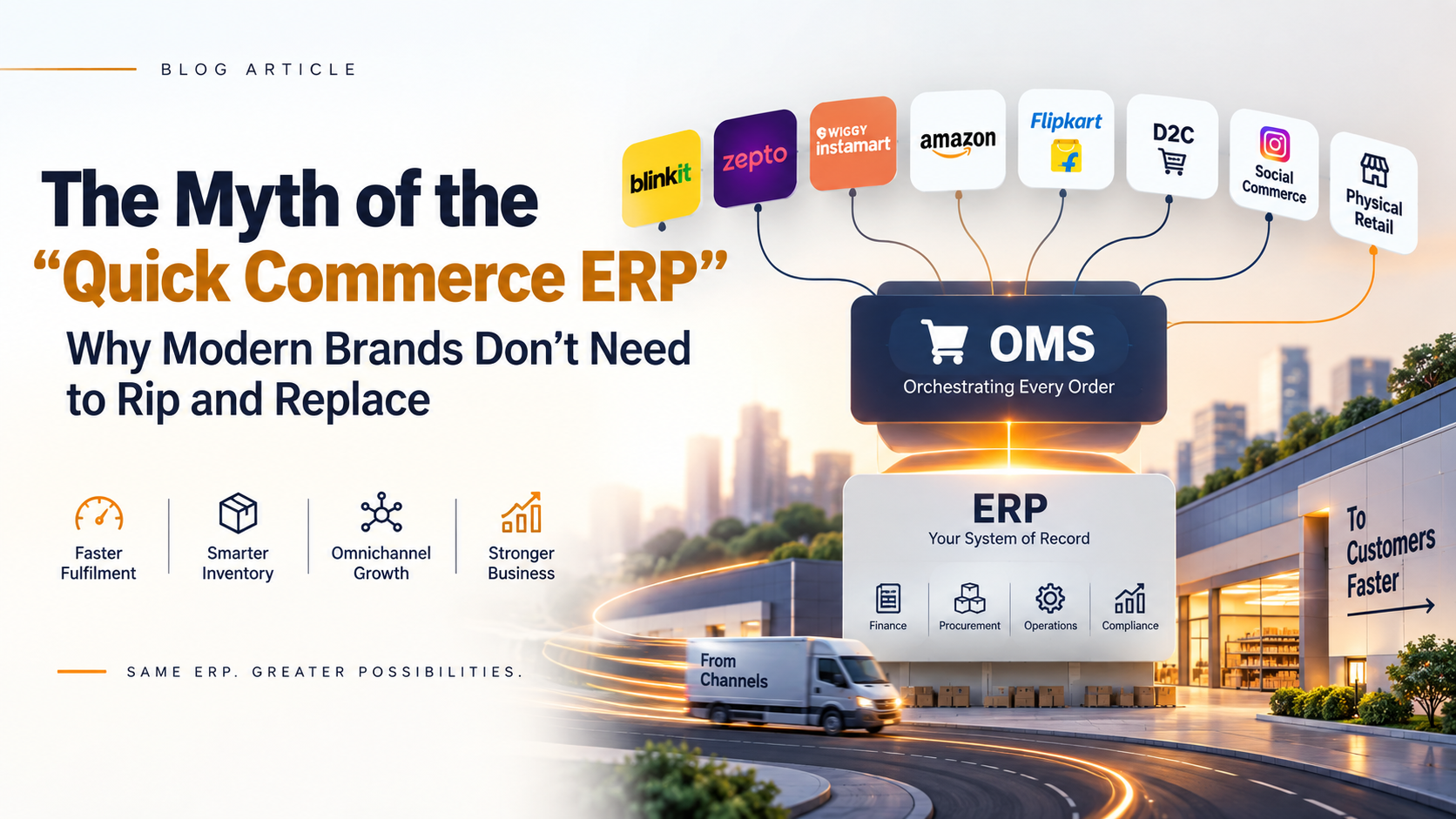
How to Connect Your ERP to Blinkit, Zepto, Amazon and Instamart
To connect your ERP to Blinkit, Zepto, Amazon or Swiggy Instamart, you need an integration layer that maps each channel’s orders, product codes and fulfilment requirements to your ERP. API-based integrations are possible, but access and supported transactions depend on the platform and your vendor arrangement.
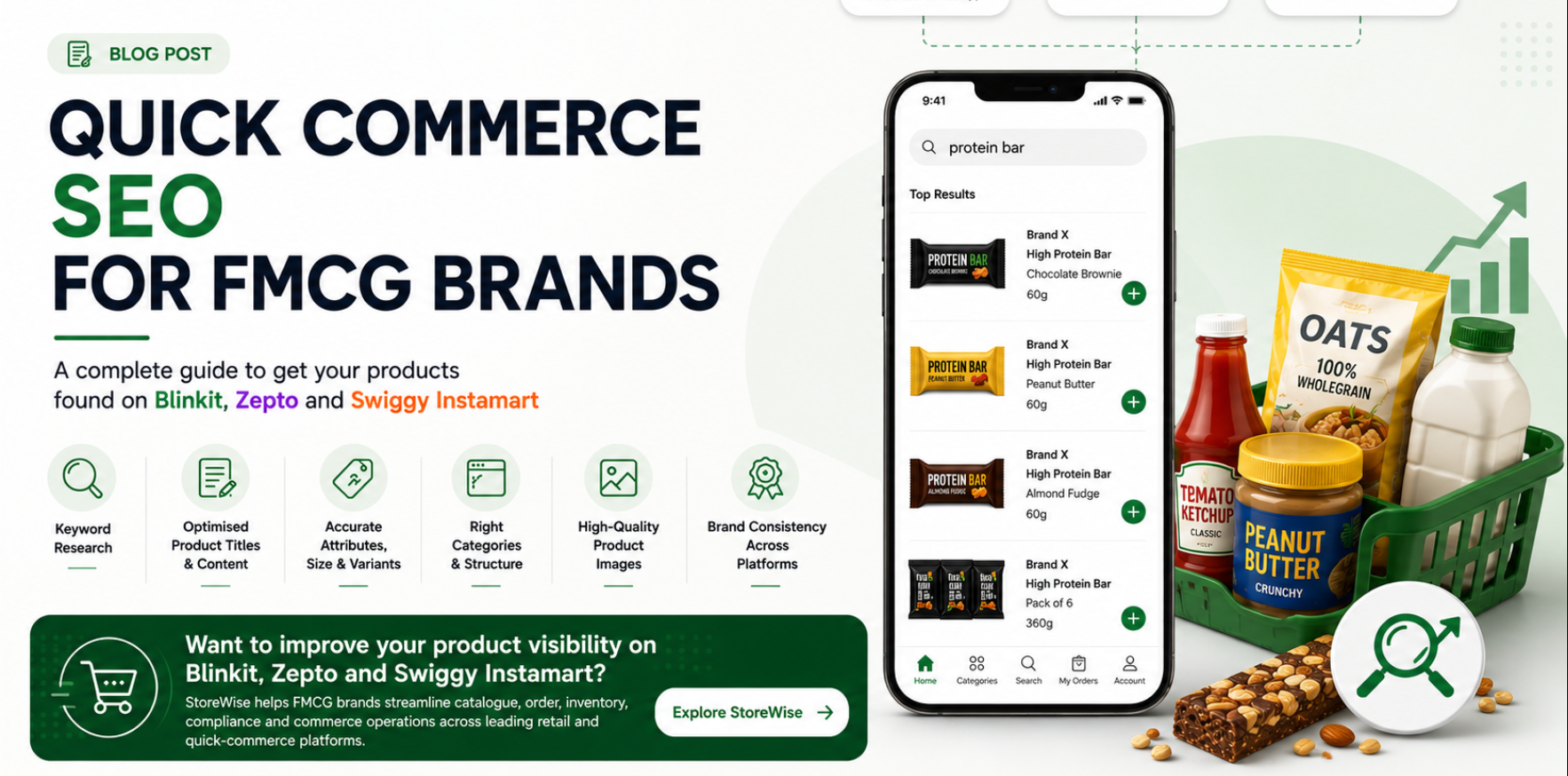
Get Found on Blinkit, Zepto & Instamart
A shopper who once planned a grocery purchase for the weekend can now search for “oats,” “face wash,” “baby diapers,” or “cold coffee” and expect delivery within minutes. For FMCG, D2C, personal care, home care, beverage, snack, and wellness brands, platforms such as Blinkit, Zepto, Swiggy Instamart, and BigBasket have become important digital shelves.
Integrating with Quick Commerce APIs
India's leading quick commerce platforms for instant delivery—Blinkit, Zepto, Swiggy Instamart, and BigBasket—are revolutionizing how brands manage supply chain operations at scale, delivering goods to consumers in as little as 10 minutes. For brands dispatching bulk inventory to fulfillment centers, API integration is the cornerstone of automated supply chain optimization for quick commerce.
A Complete Guide for Indian D2C Brands
Is your brand struggling to supply products to quick commerce platforms like Blinkit, Zepto, and Swiggy Instamart across different cities? You're not alone. Many Indian D2C brands find it challenging to manage multiple dark store deliveries while keeping their costs low. Let's explore practical solutions that actually work.